
How to Choose the Right Broom Filament Diameter (0.15–1.2 mm)
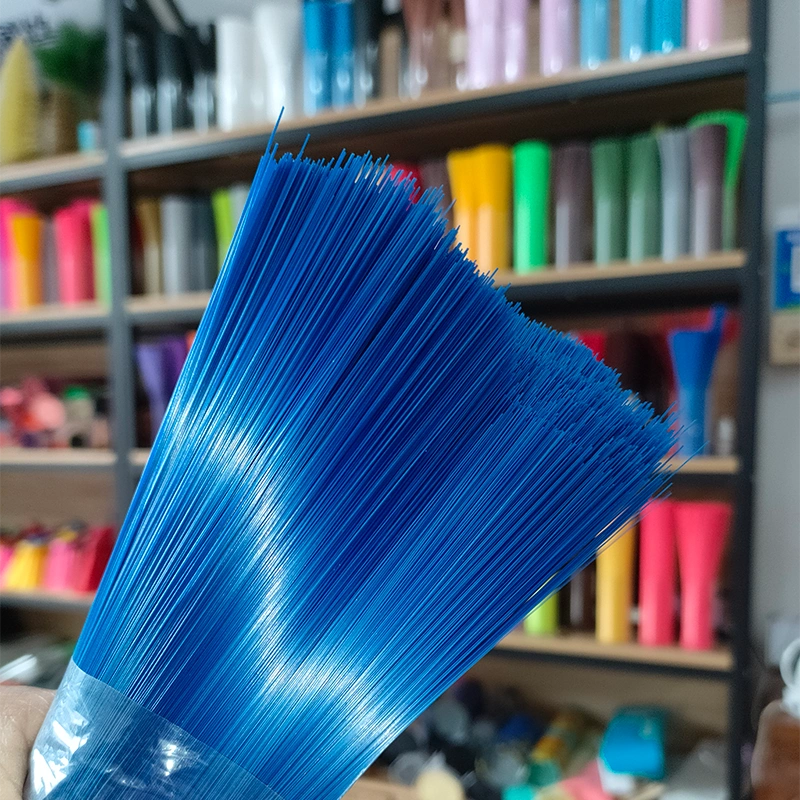
Diameter is the first specification any filament factory asks for — and the one buyers most often guess at. Between our finest 0.15 mm wire and the coarsest 1.2 mm, stiffness changes dramatically, because bending stiffness rises with the fourth power of diameter. Double the diameter and a single strand is roughly sixteen times stiffer. This guide maps the practical range to real broom applications.
What diameter actually changes
- Sweeping stiffness — thicker wire moves heavier debris; thinner wire flexes into gaps.
- Dust pickup — fine wire reaches into surface texture and holds electrostatic contact with dust.
- Wear life — heavier wire keeps its length longer on rough floors and outdoors.
- Material cost — for the same planted volume, more thin strands cost more than fewer thick ones.
Fine wire: 0.15 – 0.3 mm
At this gauge the filament feels soft and fanned. It is the standard choice for indoor household brooms, kitchen brooms and dust-only applications where the goal is collecting flour-like dust, hair and lint from smooth floors. Fine PET in this range also works well for brush refills and craft applications.
Medium wire: 0.3 – 0.6 mm
The general-purpose band. It sweeps dust and moderate debris — crumbs, litter, workshop grit — without scratching. Most classic multi-purpose household brooms sold in Europe and the Americas are planted in this range, frequently in PP for color-led retail lines.
Coarse wire: 0.6 – 1.2 mm
Thick filament is stiff enough for courtyards, streets, stables and industrial floors. It resists abrasion from concrete and aggregate, and it flicks wet or heavy debris instead of riding over it. Because stiffness is so sensitive to diameter, 0.8 mm wire can out-perform cheap 0.5 mm wire labeled "heavy duty" — check the actual gauge, not the packaging.
The premium trick: mixed planting
High-end brooms often combine two gauges — a core of medium or coarse wire for body, ringed or layered with fine wire for dust capture. The result sweeps both sand and flour, which single-gauge brooms struggle to do. If you are developing a premium SKU, ask us for mixed-diameter samples rather than choosing one compromise gauge.
Diameter interacts with material
The same 0.5 mm strand feels different in PP and PET: PET's higher bending strength and elastic recovery (200 MPa bending strength, 4000 MPa elastic modulus) give it a crisper snap-back, so PET can run one gauge finer than PP for a similar sweeping feel, with better long-term resilience.
How to specify when you order
If you already sell a broom you like, send us a sample — we measure the diameter and replicate it. For a new design, tell us the target use (indoor dust / general / outdoor heavy) and target market, and we will recommend a gauge, material and cut length. MOQ starts from 1 ton per color for standard specifications, and free samples let you sweep-test before committing.
Not sure which gauge you need?
Send your target application or an existing broom — we'll recommend the diameter and mail free samples.